My Okavango Delta safari and Victoria Falls holiday
TripBlogs
I’ve been fortunate enough to visit Africa lots in recent years, and I’ve become somewhat obsessed! It’s not just the unique wildlife, vast wilderness and vibrant cultures that excite me - I’m also inspired by the positive impact that travel can have on local communities. Every trip I’ve made has been full of heartwarming experiences, conservation stories and projects that support the livelihoods of local people.
Each destination in Africa has its own personality and charm, so when the opportunity arose for a 10-day visit to Botswana and Zimbabwe, I jumped at the chance. My itinerary combined a trip to Victoria Falls with an Okavango Delta safari, both real bucket-list experiences. I couldn’t wait!

Getting to Victoria Falls
Access to Botswana and Victoria Falls has become a lot simpler in recent years, making it easier for travellers to visit. The Ethiopian Airlines network is brilliant at connecting the whole region of East Africa. The airline now operates from UK/Europe into Maun or Gaborone in Botswana, and to Victoria Falls on the Zimbabwean side.
I flew into Victoria Falls on a lovely new A350 plane from London via Addis Ababa, and then home from Maun. This allowed me to explore everything in between overland, and it worked perfectly! Doing an ‘open jaw’ itinerary like this will really help you get the most out of your time away, as there’s no need for backtracking.
Over 10 unforgettable days, we visited Victoria Falls, Chobe National Park, Savuti, Moremi Game Reserve, Okavango Delta, Makgadikgadi National Park and the Kalahari. It was a once-in-a-lifetime trip I wholeheartedly recommend to wildlife and nature lovers.

When to visit Victoria Falls
I travelled in March, when the weather is dry and hot. It’s a fantastic time to visit Victoria Falls because rainy season has just finished, and the Zambezi waters are at their most powerful. The noise of the Falls is phenomenal, and the spray is unbelievable. I got soaked! The high waters and mists usually continue until around May, and then the volume of the Falls gradually subsides as the year goes on.
Victoria Falls shares a border with Zambia, but two-thirds of the Falls are on the Zimbabwe side. There are pros and cons to visiting from the Falls from each side, and the best time to visit differs on each side. In general, you’ll see more on the Zimbabwean side. However, on the Zambian side, you’ll find the unique ‘Devil’s Pool’, which usually opens around mid-August. It’s surely the world’s ultimate infinity pool!

When to visit Botswana
As for visiting Botswana in March, you’ll find hardly any other tourists. We sometimes drove for hours without seeing another safari vehicle. However, despite March being low season, we still saw lots of incredible wildlife, and the Okavango Delta was beautiful.
The benefit of travelling off seaon is that the lodges are cheaper and it’s much quieter in the national parks and private reserves. I thought it was a brilliant time to visit Botswana.
The traditional high season for Botswana runs from June to October. This is the coolest and driest time, but conversely, it’s when the waters in the Okavango Delta are at their highest. The rains arrive downriver from the Angola Highlands, a journey that takes many months. When these waters arrive they fan out wider to reveal one of the world’s most iconic inland wetlands.

Staying at Pioneers Lodge
I spent a wonderful first night at the new Pioneer Lodge in Victoria Falls, and I was pleasantly surprised at how safe the town felt. You can walk down to the Falls from the lodge with no problems, or you can hire e-bikes and pootle around the area, which is flat.
Pioneer Lodge is fully solar-powered, with a lovely pool, tropical gardens, and a relaxing restaurant area. I could have easily spent a few days here - it’s the perfect base for the start or finish of any Botswana adventure.

The journey into Botswana
After exploring the Falls for 2 or 3 hours the following morning, we headed for Botswana, which is just a short drive away. The border crossing at Kazungula between Zimbabwe and Botswana is easy to navigate and we were supported all the way by our excellent guide. The roads are good in this area, so it was a smooth and comfortable journey.

Staying at Chobe Elephant Camp
Chobe National Park is just an hour from the border and it’s a true wildlife paradise. Our comfortable lodge, Chobe Elephant Camp, was just five minutes from the park gates. As well as being a great region for a jeep safari, you can also enjoy a boat trip on the river, explore the local villages, or take a canoe excursion along the flood plain.
We got straight into the action on a game drive. The area is famous for its elephants, and it didn’t disappoint - we saw loads of elephants. The staff at Chobe Elephant Camp are all recruited from the local villages. They greeted us with big smiles, and we felt so welcome.

As the light faded, they set up some chairs and a pop-up bar on a hillside to serve us some ‘sundowner’ refreshments. We sat overlooking the Chobe River with a local beer while the elephants enjoyed their own ‘sundowners’ at the waterhole. We were engulfed by a magical dusky red light as the sun slowly disappeared. It was a stunning start to our Botswana adventure.

Switching into safari mode
A feature of any safari is an early start, as the animals are most active at dawn and the best wildlife viewing is early morning. Equally, if your day involves a long journey, you’ll want to hit the road as soon as possible. What I love about safari holidays is that the journeys are part of the experience, not just a way of getting from A to B.
For the next week, we had early nights, 5.30 am wake-ups, hearty breakfasts and then hopped straight into our 4x4. Botswana is very flat, and there are some big distances to cover. Our early morning routine soon became the norm.

Chobe National Park to Savuti
Once we left the Chobe region, we said goodbye to the tarmac for a few days too. The ‘main road’ from Chobe to the Savuti region was typical of roads for the rest of the week, it’s bumpy and dusty but that’s all part of the adventure.
The 4x4s glide through this terrain, and our journeys were full of spontaneous wildlife moments by the roadside (elephants, giraffes, lions, birds of prey, a cobra and a very cute tortoise). Our guides knew all the best spots to stop for coffee, often by a watering hole which busy with wonderful wildlife.

Seeing the Savuti lions
For my second night in Botswana, we were ‘premium mobile camping’ in Savuti. This glamping experience blew me away, and I’d massively recommend it. We arrived for a delicious lunch, and then immediately set off to explore Savuti.
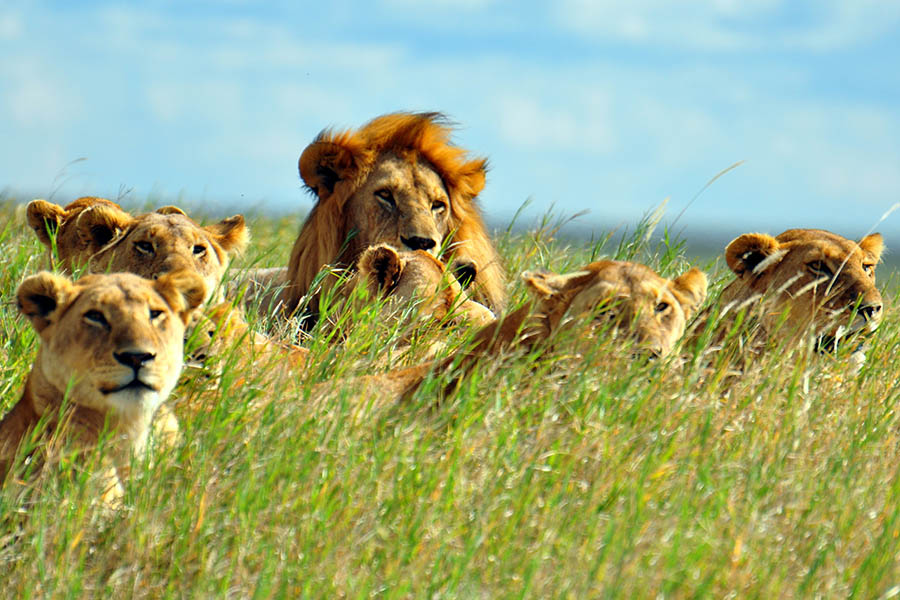
I’ve been on lots of safaris, but I’ve never had a lion encounter like the one I experienced in Savuti. Heading back to camp, just as the sun was setting, we stumbled across a pride of fourteen lions by a watering hole, including mums, dads, and cubs. We just quietly parked up and we were the only vehicle around. We stared in awe for ages, watching the cubs playing around while the setting sun provided the perfect backdrop. Wow.
Back at camp, we quickly realised we were in the heart of the action (those lions weren’t far away!). With premium mobile camping, there are no fences, just a campfire, canvas, and the sounds of the African bush.
We had the most magnificent meal that night, followed by an Amarula (a bit like Baileys) around the fire, before retiring to bed. The tents have a comfy proper bed, as well as solar lights, a private ‘natural’ loo, and shower to the rear. I lay there listening to the sounds of the bush as a cool evening breeze flowed through the tent. I slept like a log.

Visiting Khwai village
Next, we moved towards the Okavango region, passing via the Mababe Depression, where we saw more lions hanging out by the regular roadside. We stayed in Khwai village at the local Khwai Guesthouse, a small community area near to the Okavango Delta.
During our stay, we visited the local kids’ kindergarten, which is part-funded by stays at the guesthouse. It’s a great idea to include community experiences like this in your trip, because it adds real variety to the itinerary. The kids even sang us a special local song.

Exploring the Okavango Delta
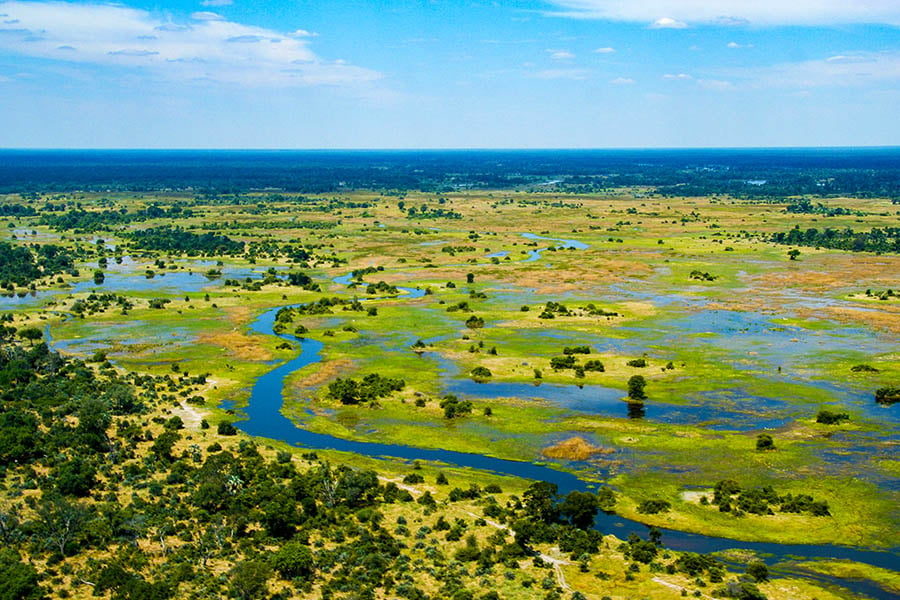
I had two incredible experiences during my stay here. The first was a short helicopter ride over the Okavango Delta. It was my first time aboard a helicopter, and I was a little nervous at first, but the fear soon faded, and I had a big grin throughout the flight. Besides being an exhilarating ride, seeing the Delta from above is breathtakingly beautiful.
The second experience was a wildlife-spotting boat ride in a traditional mokoro (dug-out canoe). It’s a truly relaxing activity and a wonderful wilderness experience, unique to this area and packed with exotic birdlife, butterflies, and cute little frogs.

Staying in the Central Kalahari
After a quick overnight near Makgadikgadi National Park, where we saw a spectacular zebra migration from the Boteti River area, we moved on towards the Central Kalahari. We spent the last two nights of our trip here, staying in the lovely Deception Valley Lodge, which us located in a private reserve just outside the Central Kalahari Reserve.
It was very dry in March, but the lodge benefits from a couple of watering holes, so the wildlife regularly comes for a drink. The viewing deck is beautifully done, with comfy sofas, armchairs, and swing chairs. You can simply sit back and admire the incoming flow of wildlife.
During our stay, we saw elephants, zebra and giraffes at the waterhole, which was less than 10 metres away. At night, we saw lions, honey badgers, and porcupines. It was magical.

This region of the Kalahari is famous for its bushmen tribes, and we enjoyed learning all about their fascinating history and culture. Many of the local bushmen are now integrated into lodge life as wildlife ‘spotters’ and guides. Their spotting skills are remarkable, even in the dark! After a wonderful last evening meal, we headed back to Maun the next morning to fly home.

Behind the scenes of my Botswana safari
On our way to the airport, I stopped by the Head Office of our local safari operator, which surely has the strongest mobile safari set-up and support centre in the region. There’s an amazing operations team behind the scenes to prepare every safari, with a dedicated team of mechanics, spare parts and food supplies.
It’s such a well-oiled machine which provides 24/7 support and ensures that any 4x4 can be back on the road (usually same day) should there be any mishaps. That’s extremely impressive when you consider the huge distances in Botswana, so you’re in very safe hands.

My thoughts about Botswana
Botswana is often seen as an expensive safari destination, but I left with the impression that it doesn’t have to be. It’s a vast wilderness which is perfect for classic mobile safari camping. The premium mobile camping that I experienced in Savuti was such a highlight for me, and choosing this option helps keep the cost down.
It’s ‘premium’ because it’s a fully serviced safari experience. A separate 4x4 goes in advance to set up camp, so you don’t have to lift a finger. All meals and drinks are included, the guides keep everyone safe, and the tents have comfy beds, as well as a rustic ensuite. There’s a wonderful candlelit dinner, plus a campfire to enjoy the stars and conversation with campmates. What’s not to like? I can’t wait to go back.

Ready to plan an Okavango Delta safari and Victoria Falls holiday?
We’re experts at building tailor-made Africa safari holidays, round the world trips, and once-in-a-lifetime adventures. Every trip that we create is completely unique and tailored to the personal needs of each customer.
Whether you’re planning a honeymoon, celebrating a special occasion or taking a well-earned sabbatical, we can help. To start planning your holiday, simply give us a call on 1273 320 580 or send us a quote request by email.

Northern Circuit: the perfect Tanzania safari itinerary
Bryony Dunn
Marketing Manager
at Travel Nation
My spectacular Uganda safari
Grainne Sheffer
Senior Travel Consultant
at Travel Nation
My top tips for planning a Tanzania family safari
Jonny Goodall
Managing Director
at Travel Nation
About the author Jonny Goodall
Managing Director
Not ready to settle down after university, Jonny headed out on his travels. His stand-out travel highlights are self-drive through Namibia’s photogenic red dunes, a pit stop to visit the Moai statues on remote Easter Island and a month spent off-grid by a lagoon in Moorea, French Polynesia. Jonny joined Travel Nation in 2005 as a round the world specialist and is now our Managing Director. When he’s not working, you can find him playing tennis, planning his next family holiday or tending to his veggies.